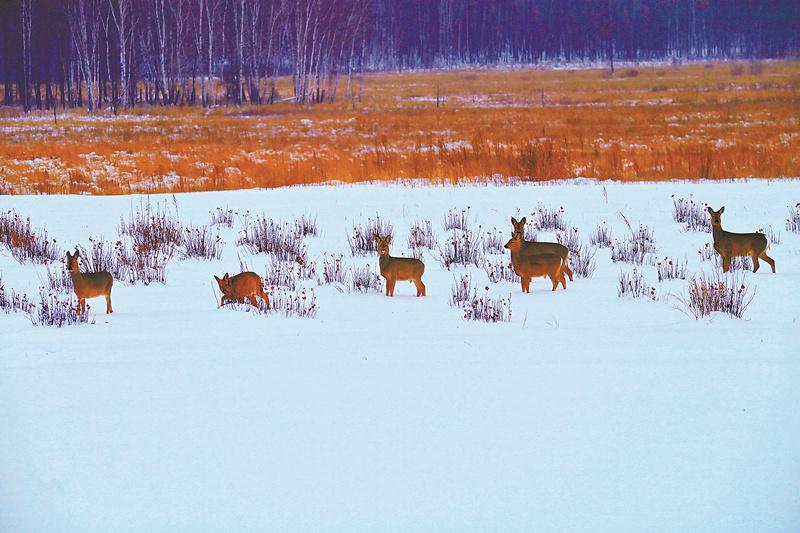
A family of roe deer has 6 mouths.
Recently, the reporter accompanied the staff to carry out patrol work in the application area of Songling Forestry Bureau of Daxinganling Forestry Group Company, and came across a variety of wild animals in the forest area. Among them, the scene of roe deer and their friends enjoying themselves in the snow was unbearable.
The roe deer is one of the most common wild animals in the northeast forest region, and the northeast people call it "silly roe deer". Zhangzi’s curiosity is very strong. When he sees someone filming in the distance, he won’t run away, but stops in the same place and looks around to see what happened. In the cold winter, they either lie down and rest, chase and play, or feed to satisfy their hunger. This reporter took a picture of a group of six roe deer family playing and running in the snow.
Moose, also known as elk and Yi Dahan, has a brighter black color against the white snow, and they have thick fur to keep out the cold.

elk
Lynx is the least afraid of cold among cats. They look very distinctive. Their faces are like tigers, and there are a bunch of 4-5 cm black tufts of hair standing up at the tips of their ears on both sides, like feathers on the helmets of military commanders in drama, which is very dignified and imposing. In the heavy snow all over the sky, it is light, moving around, and with its huge soles, it can even quickly chase its prey on a snowy embankment two or three meters thick. It weighs only 15-30 kilograms, but it can hunt wolves and deer when food is scarce, and it is regarded as a mysterious snowy night elf.

lynx
Since 2018, Songling Forestry Bureau has continuously improved wildlife habitat protection measures, innovated the grid monitoring process, introduced the "two-step" technology of mobile phone software, laid more than 40 sample lines, set up 140 infrared cameras, and the monitoring range reached more than 4,000 hectares, capturing more than 5,000 GB of effective monitoring videos. For the first time, the national second-class protected wild animals, gray wolf, Mountain hare, brown bear, red deer and lynx, were monitored. Complete monitoring of the national first-class key protected wild animals such as musk deer, mink bear, sable track and moose population foraging and other moving images; Wild birds under national second-class protection, such as swan, mandarin duck and merganser, frequently appear in the monitoring lens; The same infrared camera often captures the "same frame" pictures of many kinds of wild animals. This fully reflects the good biodiversity and ecological integrity, fixed habitat and complete food chain in Songling forest area, which provides an important foundation for continuing to study wildlife habits and habitats. (Guo Sumin, Tian Yanlong)

关于作者