Every reporter | Lin Zichen every editor | Dong Xingsheng
As winter approaches, about 6.7 million psoriasis patients in China will once again face the aggravation period of "sores all over the body and abnormal itching", and some of them may have been entangled with this skin disease for more than ten years, and they can’t escape the pain of recurrence every year.
On October 29th, it was world psoriasis day, and the Report on the Insight into the Recurrence of Psoriasis Patients in China (hereinafter referred to as the Report) was officially released. The report was initiated by Beijing Bethune Public Welfare Foundation, with the scientific advocacy of "Life and Medicine" by Beijing Health and Wellness Committee and the public welfare support of Jansen China, covering 30 provinces and involving 427 patients.
The report shows that biological agents, as an innovative treatment, have significantly improved the prognosis of psoriasis patients, but among more than 94% psoriasis patients who meet the treatment conditions of biological agents, biological agents are still a minority. Psoriasis biological agents still have some pain points, such as high price, unable to maintain long-term effect and high frequency of needle use.
As an immune-mediated chronic skin disease, psoriasis has an apt common name "psoriasis", that is, the skin lesions of patients are as hard as cowhide. Zeng Guofan once mentioned in a letter that "I have sores all over my body, which are extremely itchy and extremely bitter", which is a typical symptom of psoriasis.
According to the report, the survey sample includes 216 male patients and 111 female patients. From the patient’s portrait, the pain of this erythema covered with multiple layers of silvery white scales mostly falls on young people aged 18-35 and middle-aged people over 35, and the incidence rate is higher in men.
The report shows that psoriasis is difficult to be completely cured, and there is a certain heredity. About 30% of patients in the blood family have this disease. Most patients have been ill for a long time, the average illness time is more than eight years, and the course of disease is as high as 65% over ten years. With the increase of illness years, patients relapse more frequently. Lower limbs, scalp and trunk are the body parts with high recurrence frequency, and they are also the TOP3 parts that are the most difficult to improve. Patients with recurrence less than 3 times think that the skin lesions in scalp are the most difficult to improve.
Specifically, in the survey, the average number of patients recurred was about 8 times, and nearly 60% of patients recurred more than 10 times; The average recurrence interval after drug withdrawal is close to 6 months, and nearly 70% of patients perceive that recurrence is regular, and nearly 40% of them have recurrence interval within 3 months after drug withdrawal.
Recurrence has brought serious troubles to patients’ daily life. The survey shows that psoriasis has a great impact on the quality of life of patients. More than 90% of patients think that the quality of life is affected, and 50% of them think that the impact is very serious.
Physically, about 60% patients have complications, over 30% patients have anxiety and depression, and patients over 35 are often accompanied by arthritis and cardiovascular and cerebrovascular diseases. More than 80% patients have serious psychological and physical problems, and more than 60% patients think that psoriasis brings troubles to life and work/study. 69% of patients said that "reducing recurrence" was the main factor to consider when choosing treatment methods.
It is worth noting that the utilization rate of innovative drug biological agents that can significantly prolong the recurrence interval is not high in the patient population. According to the Guidelines for the Diagnosis and Treatment of Psoriasis in China (2022 edition), at present, domestic and foreign guidelines suggest that biological agents can be used as the first-line treatment for moderate and severe plaque psoriasis, but the report points out that the application scope of biological agents is far from matching its efficacy and recognition. More than 94% of the patients interviewed meet the treatment conditions of biological agents, but the number of users is still small.
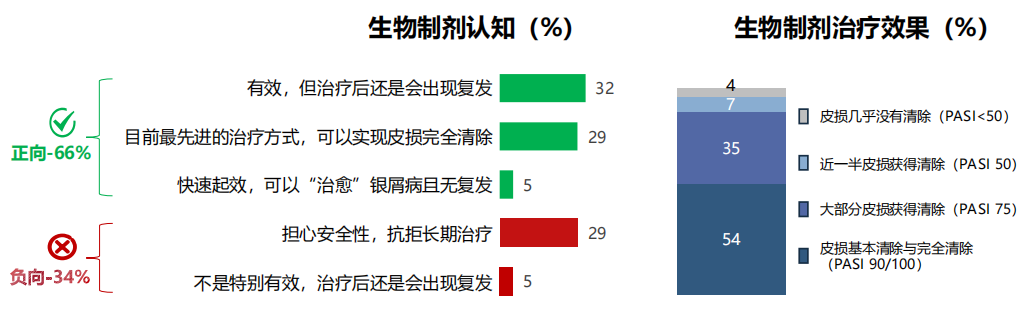
Image source: screenshot of the Report
The treatment of psoriasis includes external drugs, traditional Chinese medicine treatment, oral western medicine, phototherapy, biological agents, etc. In recent years, the sales of biological agents have been significantly higher than that of chemical drugs. According to the research report of Southwest Securities, according to the analysis of PDB (Drug Comprehensive Database) sample hospitals, in 2020 and before, the chemical drug carbotriol occupied the leading position in the anti-psoriasis drug market. Since 2021, the rapid volume of Scochizumab has been increased, and the sales in sample hospitals accounted for over 65% in 2022, ranking first.
Scuchizumab is an interleukin -17A inhibitor (IL-17A). According to the report, IL -17A inhibitors are most used in patients (77%), and other biological agents — — Tumor necrosis factor -α The practicality of inhibitors (23%), interleukin -12/23 inhibitors (12%) and interleukin -23 inhibitors (5%) decreased in turn.
At present, four IL-17A antibody drugs have been listed abroad, namely, Scochizumab from Novartis Pharmaceutical, Yiqizumab from Lilly Pharmaceutical, Berdaruzumab from Concord Fermented Kirin, and Bigelizumab from Youshibi Pharmaceutical. The first three drugs have been listed in China, among which the medical insurance price of Scochizumab is 870 yuan/injection, and the medical insurance price of Yiqizumab is 1218 yuan/injection. Among domestic companies, similar drugs of Hengrui Pharma (600276.SH, share price of 45.4 yuan, market value of 289.607 billion yuan), Times Sunshine and Zhixiang Jintai have reached the stage of application for listing, and the drugs under research of Sansheng Guojian (688336.SH, share price of 22.15 yuan, market value of 13.662 billion yuan) and Kangfang Bio have reached the third phase of clinical trials.
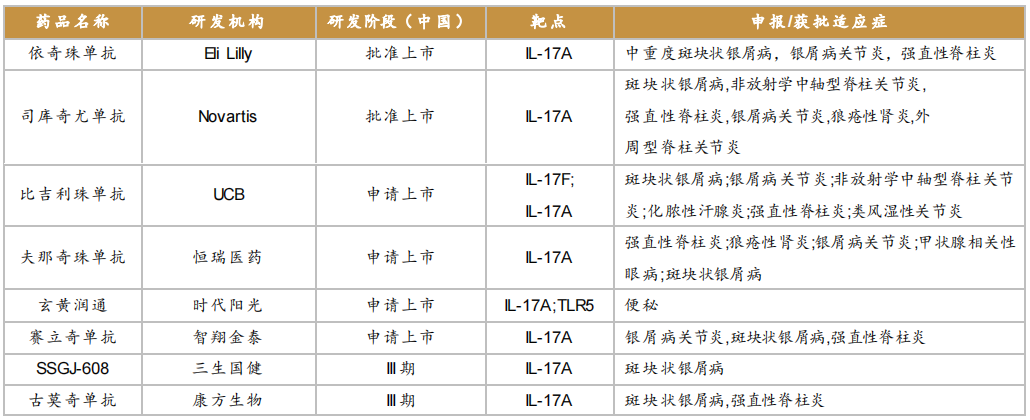
Image source: Southwest Securities Research Report
Based on Jost Sullivan’s prediction that the number of patients with psoriasis in China will reach about 6.85 million in 2030, IL-17A antibody drugs have a broad market. However, it can not be ignored that psoriasis biological agents still have pain points in terms of high price, inability to maintain long-term effects and high frequency of needle use. How to eliminate patients’ concerns about the safety of needle use and enhance patients’ cognitive breadth and depth is an important focus of biological agent manufacturers.
In addition, psoriasis can not be cured at present, and patients with moderate and severe psoriasis should continue to control the progress of the disease even if they receive systematic treatment to improve their condition. The report pointed out that in the process of receiving biological agents, some patients began to ignore lifestyle management because they obtained far more than expected curative effects of biological agents, thus increasing the risk of disease recurrence; Some patients said that due to the high frequency of administration of biological agents currently used, they are busy with work or study, so it is difficult to go to the hospital for regular follow-up visits to get medicines; Some patients also mentioned that there was poor compliance and self-medication reduction, which led to poor curative effect. These behaviors laid a hidden danger for recurrence.
Cover image source: vision china -VCG111321598414

关于作者