Xinhua News Agency, Beijing, November 5th Question: The EU "de-risks". Why do European enterprises make a record investment in China?
Xinhua News Agency reporter Xu Supei
According to the statistics of American Rongding Consulting Company, in the second quarter of this year, EU enterprises’ investment in green space in China soared to 3.6 billion euros, the highest level on record. At present, on the one hand, the EU imposes tariffs on China’s electric vehicles, on the other hand, EU enterprises represented by German automakers continue to deeply cultivate China. Rongding Consulting pointed out that the growth of European investment in China is "surprising" when the EU pursues the economic "risk-removing" policy.

In fact, most of the recent investments of EU enterprises in China are aimed at promoting localized production, and avoiding the influence of geopolitical situation and trade barriers in China is one of the important reasons. This shows that although external shocks such as politicization of economic and trade issues have accelerated the restructuring of global value chains, the core factors that affect the restructuring are still technological development and the optimization behavior of market players. The importance of China as an investment destination has not changed, and the attractiveness of China market makes people unable to give up.
Over the years, China has become a hot spot for international capital to compete for investment with its super-large-scale market, independent and complete modern industrial system, sufficient industrial workers’ reserves and generous policy dividends. Despite the slowdown in world economic growth and the overall downturn in global foreign investment, resource elements continue to flood into China. Rongding Consulting pointed out that many enterprises have carefully investigated other markets in the past few years and found that these markets are hard to compete with China in terms of cost, supply chain and logistics. Cook, CEO of American Apple, said that "there is no place more important than China" for Apple’s supply chain. Huang Jinbang, general manager of Qatar Airways Greater China, believes that the diversity and sustainable growth potential of the China market are the powerful driving force for Qatar Airways to deeply cultivate here for a long time.
At present, "in China, for China" has become the core strategy for many foreign-funded enterprises to develop in China, and "investing in China means investing in the future" is the general consensus of global enterprises. Eight well-known foreign pharmaceutical companies, including Lilly, Pfizer, Bayer and Medtronic, have indicated that they will set up new R&D and innovation institutions in Beijing. A total of 3,496 exhibitors from 129 countries and regions participated in the enterprise exhibition of the 7th China International Import Expo being held in Shanghai, and the number of countries (regions) and enterprises exceeded the previous one. Zhong Zhonglin, CEO of Nippon China, said that for the first time in China International Import Expo(CIIE), Nippon "not only shows our innovative products and technologies, but also shows our long-term commitment and confidence in the China market". According to him, at present, Nippon has established 74 factories and 10 R&D centers in China. In August this year, Nippon launched the construction of Nippon Asia-Pacific R&D Innovation Center in Pudong, Shanghai.
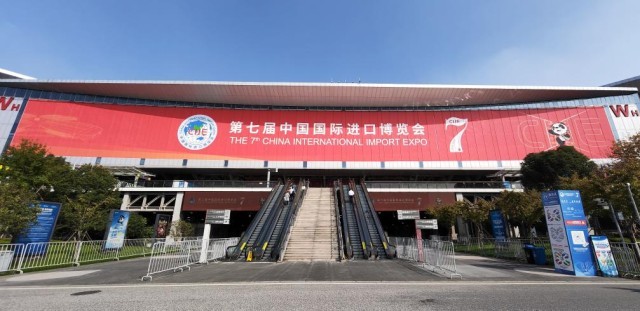
This is the location of the National Convention and Exhibition Center (Shanghai), the venue of the 7th China International Import Expo, which was filmed on November 4th. Xinhua News Agency reporter Yin Gang photo
Behind "in China, for China", foreign capital continues to be optimistic about the development prospects of China market. China is continuing to create a market-oriented, rule-of-law and international first-class business environment; China has a large market scale and sufficient consumption potential, which constantly brings development momentum to foreign-funded enterprises; China is constantly improving the toughness and safety level of the industrial chain supply chain, giving full play to the advantages of a sound industrial supporting system, and supporting foreign-funded enterprises to deeply participate in the international cycle. The data shows that the rate of return of foreign direct investment in China in the past five years is about 9%, ranking among the top in the world.
Rongding Consulting pointed out that compared with previous years, the strong growth of European direct investment in China is mainly concentrated in the automobile industry, and German automakers account for the vast majority of foreign direct investment in China related to automobiles in the European Union. Since Volkswagen first entered China more than 40 years ago, German auto companies have witnessed and participated in the continuous development of China’s auto industry. According to the report of PricewaterhouseCoopers, in 2023, the sales volume of pure electric vehicles produced by German automakers in China market increased by nearly 50% year-on-year, and the sales volume in China increased considerably. At the same time, German automakers are still upgrading their existing production facilities and promoting the localization of the supply chain. Ferdinand Dudenhofer, an authoritative expert in automobile economics in Germany and president of Bochum Automobile Research Institute, said that German and Chinese automobile companies are very much looking forward to strengthening cooperation. "If we can go hand in hand, the future of the automobile industry will be very beautiful."
The so-called "going to risk" is tantamount to "going to development" and "going to opportunities". Facts have proved that only by encouraging independent innovation, embracing open cooperation and persisting in long-term doctrine can we have the opportunity to tread the waves in industrial innovation. As Finnish President Stub, who visited China a few days ago, said, protectionism and nationalism are rampant at present, which cannot be ignored. "Without free trade, there would be no growth; Without growth, there will be no welfare. "

关于作者