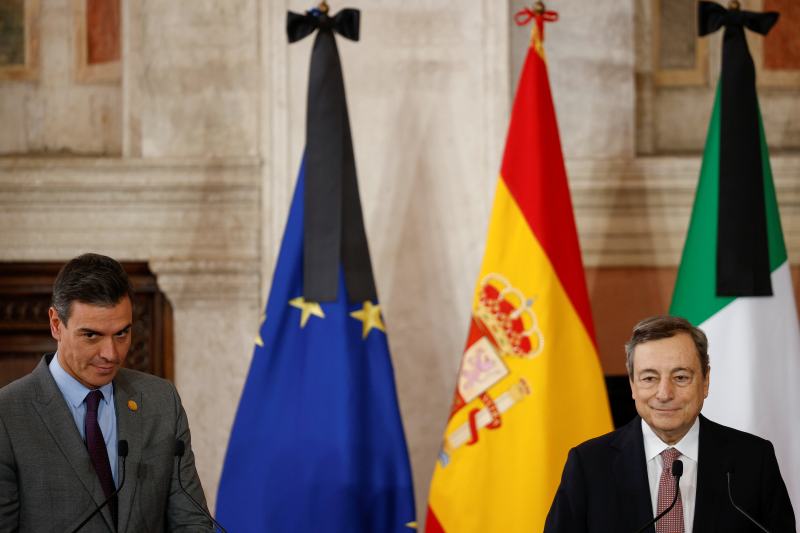
▲ On March 18th, 2022, local time, Italian Prime Minister Mario Draghi met with Spanish Prime Minister Sanchez, Portuguese Prime Minister Costa and Greek Prime Minister Mitsotakis on energy issues. The main purpose of this meeting is to give the countries near the Mediterranean the direction of action on energy issues, and to coordinate their positions in advance for the EU Council to be held on March 24-25. Figure /IC photo
The Russian-Ukrainian crisis has disrupted the pace of European economic recovery.
On May 5, the Bank of England announced that it expects GDP growth of 0.9% in the first quarter of 2022, and GDP growth in the second quarter may be zero.
On April 29, the French National Institute of Statistics and Economics announced that its GDP growth in the first quarter was zero. Italy’s National Bureau of Statistics announced that the GDP in the first quarter decreased by 0.2% from the previous quarter.
On April 22, the Bundesbank said that in the first quarter of 2022, Germany’s GDP increased by 0.2%, and the German economy has "more or less stagnated".
However, just three months ago, these European countries were still full of confidence in their economic prospects.
On February 10th, two weeks before the conflict between Russia and Ukraine broke out, the European Commission announced that the GDP growth in the euro zone is expected to reach 4.0% in 2022, and all EU countries will return to the pre-epidemic economic level by the end of 2022.
At the end of the report, valdis dombrovskis, Executive Vice President of the European Commission, predicted hopefully: "With the full implementation of economic recovery plans in all countries (from 2022), the (EU) economy will be further boosted."
The Russian-Ukrainian crisis broke this expectation.
On April 22nd, the International Monetary Fund issued a report, which revised its economic outlook data at the beginning of the year. The report lowered the forecast of world economic growth in 2022 from 4.9% to 3.6%, which is the third largest decline in the forecast adjustment of the organization in the past 15 years. The other two times correspond to the global financial crisis in 2008 and the global epidemic in early 2020.
On April 29th, Eurostat revealed that in the first quarter of 2022, the GDP in the euro zone increased by only 0.2% month-on-month, and the inflation rate in the euro zone has reached 7.5%, which is the highest value in 25 years. Among them, the increase in energy prices contributed 38% to this record inflation.

▲ On March 23rd, a dairy product shelf in a supermarket in caceres, Spain. The increase in fuel prices has affected the market supply of some commodities in Spain..Figure/Xinhua News Agency
Developed economies: energy is the main channel for the spillover of the Russian-Ukrainian crisis
The impact of Russia-Ukraine crisis on developed European economies is mainly reflected in energy trade, production supply chain and consumption level.
Energy is the main channel for the spillover of the Russian-Ukrainian crisis. Based on various data, more than 20 European countries have energy dependence on Russia, among which Germany, Austria and other countries account for more than 60% of their domestic supply of Russian natural gas. According to the assessment of the European Commission, under the current sanctions against Russia, the global LNG supply capacity cannot meet the demand of Europe.
Germany’s natural gas storage level in May was about 34.2%, which was more than 11% lower than its average level in previous years. Natural gas power generation in the month also decreased by 5.4% year-on-year. During the first quarter, German fuel prices rose by about 20%.
Another serious impact of the Russian-Ukrainian conflict on the regional economy is reflected in the supply chain. According to the analysis of the international shipping network, in March and April this year, container shipping companies raised the fees such as "container comprehensive rate surcharge" and "fuel surcharge" respectively, and the increase in international shipping prices is likely to rise by 50%. According to the German Statistics Bureau, as of April this year, about 79% of industrial enterprises in Germany reported that their supply chains had been "significantly affected", and 36% of them said that their supply chains had been "seriously interrupted".
European countries are facing record high inflation because of the rising energy prices and the blocked supply chain. At the end of the first quarter, German inflation reached 7.6%. Since the end of World War II, Germany has experienced this level of inflation only during the oil crisis in the 1970s and the reunification of Germany in the 1990s. Domestic experts pointed out that if the crisis continues to expand, Germany’s inflation rate will increase by 2.3 percentage points on the existing basis.
On April 21st, Eurostat released data, and the inflation rate in the Netherlands reached 11.7% in March, the highest level since 1975. On April 29th, INSEE announced that its inflation rate would reach 4.8%, the highest in France since 1980s. On May 5th, the Bank of England issued a warning that the inflation rate in Britain may exceed 10% this year, and raised interest rates to 1% to deal with inflation. The last time Britain rose to this level, it was the global financial crisis in 2009.
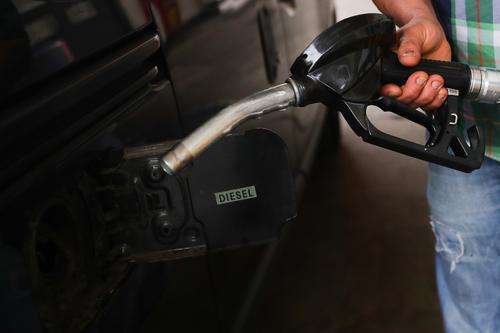
▲ On March 29th, 2022, a man refueled his vehicle at a gas station in Brussels, Belgium. The World Bank released a report on April 26th, saying that the conflict between Russia and Ukraine had a "great impact" on the commodity market and changed the global trade, production and consumption patterns. Figure/Xinhua News Agency
In addition, the Russian-Ukrainian crisis has also affected regional export trade. In March, EU exports fell by 5.6%, while imports fell by 3.4%. Compared with February, Germany’s trade with Russia decreased by 62.3%, about 900 million euros, accounting for about 22% of its total trade decline.
According to the forecast of the International Monetary Fund, major European economies such as Germany, France and Italy may experience negative growth in 2022.
Strong growth in a few countries: excess returns under global inflation
As of May 7th, among more than 30 European countries that have released some economic data for the first quarter, Portugal and Austria are the most outstanding economies. On April 29th, Vienna Economic Research Institute evaluated Austria’s economy as "strong growth" in the new year, with GDP increasing by 2.5% in the first quarter. The Portuguese National Bureau of Statistics announced on the same day that its GDP increased by 2.6% in the first quarter.
Based on the information released by the two countries at present, the two countries have a common feature: under the background of global inflation, their pillar industries have gained excess returns because they have not been greatly negatively affected.
According to the Austrian central bank, its pillar industries are developing well at present: the growth rate of the construction industry will remain at 6% in the first two months of 2022, and its industrial production will increase by more than 11% during the major categories.
Taking the aluminum processing industry as an example, Austrian bauxite imports from China, Germany, India, Guyana, etc., because it is distributed across Asia, Europe and America, and far away from conflict areas, its downstream supply is not greatly affected.
According to the report released by Portuguese oil and gas company Galp Energia on May 3rd, the adjusted profit in the first quarter increased fivefold compared with the same period of last year, reaching 155 million euros, because the global crude oil price soared to the highest level in the past 14 years.
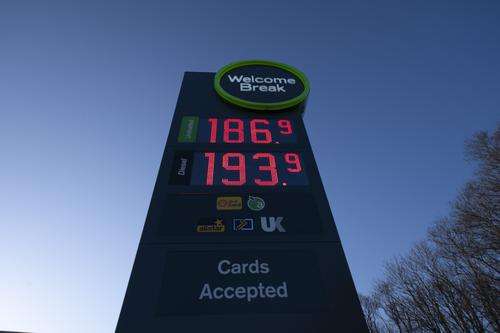
▲ On March 17, the price tag of a gas station in Warrington, England showed the rising oil price..Figure/Xinhua News Agency
Emerging economies face difficulties such as trade, refugees and capital outflow.
For the emerging European economies located in Eastern Europe, apart from the impact of high inflation and supply shortage, they also suffer from the negative impact of regional trade obstruction, refugee influx and capital outflow.
In March, the inflation rate in Serbia reached 9.1%. According to Eurostat data, Lithuania (15.6%), Estonia (14.8%) and the Czech Republic (11.9%) are also facing serious inflation crisis, and the inflation rates of these countries have reached double digits.
As far as energy supply is concerned, there may be trade and even legal disputes between Serbia, Hungary, Bulgaria and other countries that are highly dependent on Russian natural gas.
On April 27th, Russia announced that it would suspend the supply of natural gas to Bulgaria and Poland. On the 28th, the Bulgarian Prime Minister said that the Bulgarian government was reviewing its agreement to supply natural gas to a third country, implying that it would intercept the natural gas originally supplied to Serbia and Hungary. According to malkovich, an energy expert from Deloitte, once this happens, Bulgaria will face lawsuits, but Serbia will be out of gas. At present, its inventory can only meet the demand of 20 days to one month.
Some European countries are still suffering from the impact of refugee flows. According to UNHCR, at present, 5.75 million refugees have fled Ukraine, with a total scale exceeding that of Syrian refugees since 2015. The countries most affected are Poland (3.08 million), Romania (840,000) and Hungary (530,000).
In addition, according to the data of Emerging Portfolio Fund Research (EPFR), in the first five weeks of the conflict between Russia and Ukraine, the capital of emerging European countries flowed out at a rate of $300 million per week. According to Bank of America, as of March 18, the global emerging market debt fund had only 14.3 billion US dollars, half of the same period in 2021.
Blocked trade in energy and other commodities, high inflation, refugees and capital outflow are not all the problems faced by the European economy since the Russian-Ukrainian crisis.
In the short term, high inflation will aggravate the risk of social unrest in European countries, especially in Central European countries that host a large number of refugees. The soaring defense budget will further increase the financial pressure of governments.
In the long run, if the global energy trade supply chain, global payment network, countries’ reserve currencies and investment orientations change more substantially under the Russian-Ukrainian conflict, I am afraid it will take a more independent and stronger Europe to gain an advantage in these uncertain games.
Write/Kong Xue, a researcher at Xinjing Think Tank
Edit/Li Xiaoxiao
proofread/Wu Xingfa

关于作者